

If you drive in Pakistan, you already know: our summers are brutal on engines. When the temperature needle climbs past halfway on a hot May afternoon in Multan traffic — or your car starts blowing steam on the motorway — the problem is almost always in the cooling system. A healthy radiator and proper coolant stand between your engine and a very expensive overheating disaster.
This guide covers the warning signs, the best radiators and coolants available in Pakistan, what they cost, and the maintenance habits that keep your engine cool through the worst of the heat.
Quick answer: Never run your car on plain tap water long-term — it rusts the system from the inside. Use a 50/50 mix of genuine coolant and distilled water, flush it every 2–3 years, and replace a choked or leaking radiator (Rs. 4,000–12,000 depending on the car) instead of repeatedly patching it.
How your car’s cooling system works (30-second version)
Your engine runs best at around 90–100°C. The coolant absorbs engine heat, the water pump circulates it to the radiator, and the radiator — helped by the electric fan — dumps that heat into the air. The thermostat valve regulates flow, the radiator cap holds system pressure, and the overflow bottle handles expansion. If any one of these fails, temperatures spike.
7 warning signs your cooling system needs attention
- Temperature gauge climbs above the halfway mark — especially in traffic or uphill.
- Coolant level keeps dropping — check the overflow bottle weekly. A slow drop means a leak somewhere.
- Rust-coloured or brown coolant — plain water has been in the system too long; the internals are corroding.
- White steam or sweet burning smell from under the bonnet — coolant hitting a hot engine part.
- Puddle of green, red, or orange liquid under the car after parking.
- Radiator fan not kicking in — a failed fan or sensor is one of the most common overheating causes in city traffic.
- Heater blows cold air even with a hot engine — air trapped in the system or very low coolant.
The biggest mistake Pakistani drivers make: running plain water
Visit any Pakistani workshop and you’ll find cars running on plain tap water. It works — for a while. Then the rust begins: water corrodes the radiator tubes, water pump fins, and engine block from the inside. Several Pakistani owners on PakWheels have reported discovering water pumps with half their fins broken off from corrosion after years of plain-water running.
Proper coolant does four things water can’t: it prevents rust and corrosion, raises the boiling point so the system survives summer heat, lubricates the water pump, and protects in winter. The cost difference is tiny; the repair difference can be tens of thousands of rupees.
Best coolants for Pakistani cars (2026)
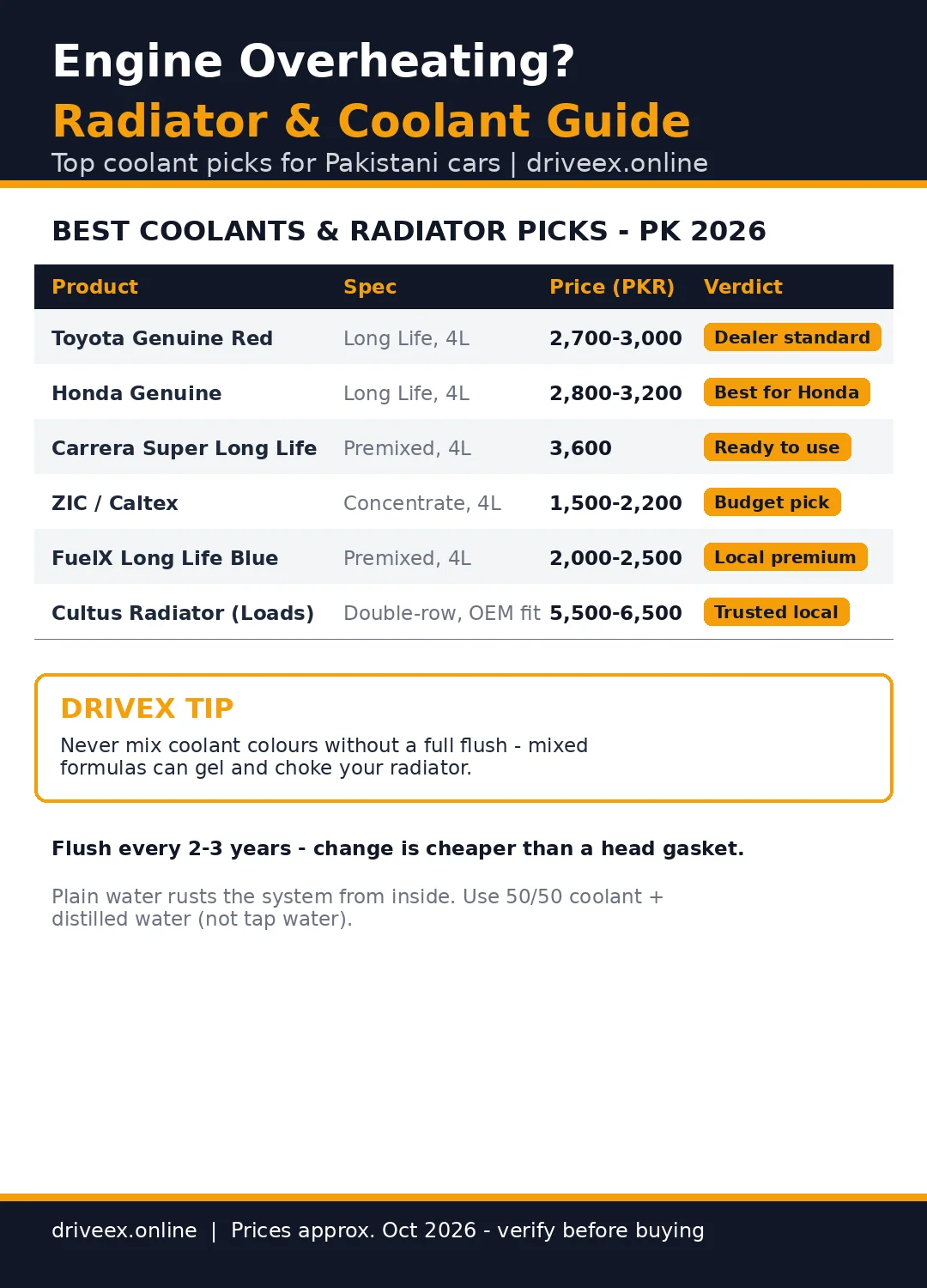
1. Toyota Genuine Long Life Coolant (Red, 4L) — Rs. 2,700–3,000
Best for Toyota owners. The red Long Life formula is what Toyota Pakistan dealerships use. It is a concentrate — dilute it 50/50 with distilled water (not tap water). Good for older Corollas and Vitz with iron blocks. Note: Toyota Pakistan stocks the red Long Life, not the pink Super Long Life found internationally — stick with what your local dealer supplies.
2. Honda Genuine Coolant (4L) — Rs. 2,800–3,200
Best for Honda owners. Honda Pakistan’s own blue/green long-life formula, premixed or concentrate depending on stock. The safest choice for Civics and Cities, and what 3S dealerships pour during scheduled maintenance.
3. Carrera Super Long Life Coolant (4L) — Rs. 3,600
Best ready-to-use aftermarket option. Premixed, so no measuring or distilled water needed. Good long-drain protection for any car, and easy to top up on the road. A solid choice if you do your own maintenance.
4. ZIC / Caltex Coolant (4L) — Rs. 1,500–2,200
Best budget option. Widely available at fuel stations and parts markets across Pakistan. Does the core job — rust protection and boiling-point raise — at roughly half the price of genuine coolants. Buy from authorised dealers, not random market stalls.
5. FuelX Long Life Coolant (Blue, 4L) — Rs. 2,000–2,500
Best local premium option. A Pakistani brand with a proper long-life formulation and good availability in online auto stores. Convenient 1L–4L sizes for top-ups and full fills.
Quick comparison
| Coolant | Pack | Type | Approx. Price (PKR) | Best For |
|---|---|---|---|---|
| Toyota Genuine Long Life (Red) | 4L | Concentrate | 2,700–3,000 | Toyota cars — dealer standard |
| Honda Genuine Coolant | 4L | Concentrate/premix | 2,800–3,200 | Honda Civic, City |
| Carrera Super Long Life | 4L | Premixed | 3,600 | Any car, DIY top-ups |
| ZIC / Caltex Coolant | 4L | Concentrate | 1,500–2,200 | Budget-friendly protection |
| FuelX Long Life (Blue) | 4L | Premixed | 2,000–2,500 | Local brand, easy availability |
Prices are approximate market prices in Pakistan as of October 2026 and vary by city and seller. Always verify before buying.
Radiator prices in Pakistan (2026)
When a radiator is badly choked, repaired more than once, or has cracked plastic tanks, replacement beats another repair. Current approximate prices:
- Suzuki Cultus radiator (Loads / Allwin brand): Rs. 5,500–6,500 from the market; ~Rs. 7,000 from a Suzuki 3S dealership for the genuine unit. Double-row versions cool better for old carby Cultus models.
- Honda Civic (older models) radiator: around Rs. 4,000–5,000 for a market replacement.
- Toyota Corolla / newer Civics: Rs. 8,000–12,000 depending on model and whether genuine or OEM-quality.
Loads and Allwin are the two trusted local radiator brands Pakistani mechanics recommend. Avoid the suspiciously cheap unbranded units (some selling for as little as Rs. 3,000) — thin cores and leaky welds fail within months.
DIY: coolant flush in one afternoon
A full coolant flush takes 2–3 hours and basic hand tools. Here’s the safe process:
- Cool engine only — never open a hot radiator cap. Let the car sit for hours.
- Drain the old coolant — open the drain nut at the bottom of the radiator into a bucket. Coolant is toxic; don’t let it reach soil or pets.
- Flush with clean water — refill with plain water, run the engine to operating temperature with the heater on hot, then drain again. Repeat until the water runs clear.
- Refill with the right mix — 50/50 genuine coolant and distilled water (battery shop distilled water, not tap water). Premixed coolants go in straight.
- Bleed the air — squeeze the top radiator hose, run the engine with the cap off briefly, and top up. Trapped air causes false overheating readings.
- Check for leaks and monitor the level for a few days after the flush.
If the system was run on plain water for years, expect rust sludge. A citric-acid flush (10% solution max, followed by a baking-soda neutralising flush) cleans it well — but if the system is heavily corroded, be prepared: cleaning can expose leaks the sludge was hiding.
Maintenance schedule that prevents overheating
- Check coolant level weekly — takes 30 seconds at the overflow bottle.
- Inspect hoses yearly — cracked, swollen, or mushy hoses burst without warning in summer heat.
- Replace coolant every 2–3 years or 100,000 km (whichever comes first) for long-life types.
- Clean the radiator fins every summer — dust and insects block airflow; a gentle low-pressure water wash from behind helps.
- Never ignore the temperature gauge — pull over, switch off, and let it cool. Driving an overheating engine warps the head gasket, and that repair starts at Rs. 25,000+.
Warning: don’t mix coolants blindly
Different coolant colours mean different chemistries (red, green, blue, orange, pink). Never mix colours without flushing first — mixing incompatible formulas can form gel that chokes the radiator. When in doubt, drain the whole system and start fresh with one brand. Also beware of suspiciously cheap “coolant” sold loose in unlabelled bottles at markets — it may be coloured water with zero corrosion inhibitors.
Where to buy genuine radiators and coolant in Pakistan
Your safest bets are Honda/Toyota/Suzuki 3S dealerships, authorized brand dealers, and reputable online auto stores. For radiators, Lahore’s Montgomery Road and Karachi’s Plaza market are the big parts hubs — but go with a mechanic you trust, and compare at least two shops before buying.
FAQs
Can I just use plain water in my radiator?
In an emergency top-up, yes — but replace it with proper coolant soon. Long-term plain-water use rusts the radiator, water pump, and engine block from the inside.
How often should I change my car’s coolant?
Every 2–3 years or 100,000 km for long-life coolants. If your coolant looks brown or rusty, change it immediately regardless of mileage.
Can I mix different coolant colours?
No. Different colours are different chemistries — mixing can create sludge that blocks the radiator. Flush the system first, then fill with one coolant.
Why does my car overheat only in traffic but not on the highway?
The radiator fan is the usual suspect — on the highway, airflow cools the radiator; in traffic, the electric fan must do all the work. Get the fan, its relay, and the temperature sensor checked.
Is a repaired radiator as good as a new one?
One professional repair can be fine. But a radiator that keeps leaking after repairs — or has choked, rotted tubes — should be replaced. Repeated repairs cost more than one new Loads/Allwin unit.
Final verdict
Overheating is almost always preventable. Keep genuine coolant at the right mix and level, replace it every couple of years, clean the radiator each summer, and fix leaks early. If your radiator is on its second or third repair, stop throwing money at it — a new Loads or Allwin radiator for Rs. 5,500–7,000 (Cultus class) is cheaper than one head-gasket job. Your engine will thank you every hot June.