

A dead battery never picks a convenient moment. It strikes on a freezing morning before work, in a dark parking lot after a long day, or halfway through a road trip miles from the nearest garage. A portable car jump starter turns that crisis into a two-minute fix — no waiting for a stranger, no flagging down help, no tow truck bill. Modern lithium jump starters are small enough to fit in a glovebox, yet powerful enough to start cars, SUVs, and even trucks.
This guide compares the best portable car jump starters of 2026, with real marketplace prices in USD, so you can pick the right one for your vehicle and budget.
Quick answer: For most drivers, the NOCO Boost Plus GB40 at around $100 is the best all-round pick — compact, proven, and powerful enough for cars and small SUVs. Budget buyers should look at the AstroAI S8 at around $53, while truck and large SUV owners should step up to the NOCO Boost X GBX45 at around $125.
How to choose the right jump starter
Before comparing models, match the jump starter to your vehicle. Buying too small is the most common mistake — a weak pack will click uselessly at a big diesel engine on a cold morning.
- Peak amps matter most. This is the burst of power the pack delivers to crank the engine. Small cars need around 700–1,000A, family SUVs around 1,000–1,500A, and large trucks or diesels need 2,000A or more.
- Match it to your engine size. As a rule of thumb, a 1,000A pack covers petrol engines up to about 6.0L and diesel engines up to about 3.0L. Bigger engines need a bigger pack.
- Check the extras. Most modern packs double as a power bank for your phone and include an LED flashlight with SOS mode — genuinely useful on a dark roadside.
- Safety protection is non-negotiable. Look for spark-proof technology and reverse-polarity protection, so connecting the clamps the wrong way cannot damage your car or hurt you.
- Mind the weight and size. A glovebox-friendly pack you actually carry beats a powerful brick left at home in the garage.
Top 5 portable car jump starters for 2026
1. NOCO Boost Plus GB40 (1,000A) — around $100
Best overall — the safest choice for most drivers. The GB40 is the jump starter most reviewers reach for first, and for good reason. At about 2.4 pounds and roughly the size of a small hardcover book, it fits in a glovebox or motorcycle bag. Its 1,000-amp rating handles petrol engines up to 6.0L and diesel engines up to 3.0L, and it delivers up to 20 jump starts on a single charge. NOCO’s UltraSafe technology is spark-proof with reverse-polarity protection, and the rugged IP65-rated housing shrugs off rain and dust. It also works as a power bank and has a 100-lumen LED flashlight with SOS mode.
2. NOCO Boost X GBX45 (1,250A) — around $125
Best for trucks and large SUVs. If you drive a half-ton truck, a big SUV, or a turbodiesel, the extra 250 amps over the GB40 give you a safety cushion exactly when smaller units start to struggle in cold weather. The GBX45 adds fast 60W USB-C charging in and out, so it recharges far quicker than older USB-A packs, and it keeps the same IP65 weather rating for rainy roadside work. It is bigger than the GB40, so it lives in the trunk rather than the glovebox — a fair trade for the extra power.
3. AstroAI S8 (1,500A) — around $53
Best budget pick. The S8 punches well above its price. Its 1,500A peak current starts petrol engines up to 6.0L and diesel engines up to 3.0L, and it packs eight safety protections including reverse polarity, overcurrent, and short-circuit protection. A smart boost mode detects very low battery voltage and can revive fully drained batteries. At under a pound in some configurations and roughly the size of a paperback, it is genuinely portable — and at around $53, it costs about half the NOCO GB40 while offering more peak amps on paper.
4. Hulkman Alpha85 (2,000A) — around $100
Best for larger engines on a mid-range budget. The Alpha85 delivers 2,000 amps of peak current, enough for petrol engines up to 8.5L and diesel engines up to 6.0L, and claims up to 60 jump starts on a single charge. It includes a clear LED display showing battery status, a flashlight, and a 74Wh power bank for charging devices. If you run a large SUV, a work truck, or a diesel, this is the sweet spot between the compact NOCO models and heavy professional units.
5. AstroAI A30 (4,000A, with Air Compressor) — around $80
Best all-in-one emergency kit. The A30 pairs a powerful 4,000A jump starter with a built-in air compressor, so one device covers both a dead battery and a low tyre. That combination is ideal for road trips and for drivers who want a single emergency box in the trunk instead of two separate gadgets. It is heavier and bulkier than the glovebox picks above, but for the price — around $80 on sale — it replaces two tools at once.
Quick comparison
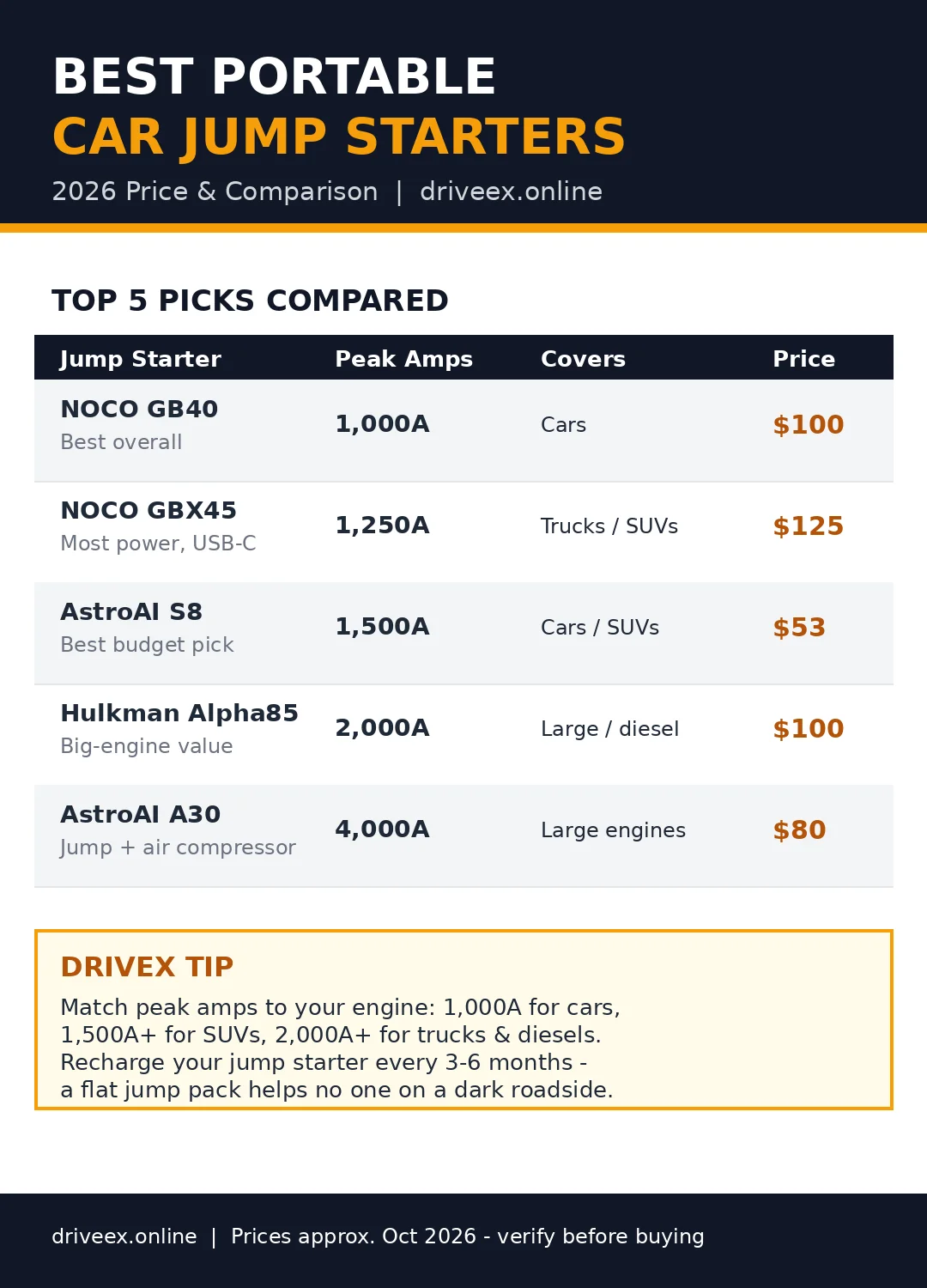
| Jump Starter | Peak Amps | Covers (Petrol / Diesel) | Extra Features | Approx. Price (USD) | Best For |
|---|---|---|---|---|---|
| NOCO Boost Plus GB40 | 1,000A | Up to 6.0L / 3.0L | Power bank, LED flashlight, IP65 | $100 | Most cars — safest pick |
| NOCO Boost X GBX45 | 1,250A | Trucks, large SUVs | 60W USB-C, IP65 | $125 | Trucks & big SUVs |
| AstroAI S8 | 1,500A | Up to 6.0L / 3.0L | Power bank, 3-mode flashlight | $53 | Budget buyers |
| Hulkman Alpha85 | 2,000A | Up to 8.5L / 6.0L | LED display, 74Wh power bank | $100 | Large engines |
| AstroAI A30 | 4,000A | Large engines | Built-in air compressor | $80 | All-in-one road kit |
Prices are approximate marketplace prices as of October 2026 and vary by seller and region. Always verify before buying.
How to use a portable jump starter safely
Using one is simpler than most drivers expect, but the order matters:
- Turn everything off — ignition, lights, radio — before connecting.
- Red clamp to positive (+), black clamp to negative (−) on the dead battery.
- Start the car within about 30 seconds of connecting. If it does not start, wait a minute and try again — never crank continuously.
- Disconnect in reverse order — black first, then red — once the engine is running.
- Let the engine run for at least 20–30 minutes (or drive it) so the alternator recharges the battery.
Never use a jump starter on a battery that is cracked, leaking, or frozen solid — that is a job for a professional, not a roadside fix.
Keep it charged — or it will let you down
The single biggest reason jump starters fail in real emergencies is neglect. Lithium packs slowly self-discharge in storage, and a pack that sat in a hot glovebox all summer may be flat on the winter morning you need it.
- Recharge every 3–6 months, even if you never used it. Put a recurring reminder in your phone.
- Do not store it in extreme heat. Car interiors can exceed 120°F (49°C) in direct sun, which degrades lithium cells. Under a seat or in the trunk is better than the dashboard.
- Top it up after every use, even a single jump, so it is ready for the next one.
- Check the indicator lights when you do your seasonal car checks — tyre pressure, fluids, jump starter charge.
Warning: a jump starter is not a battery fix
A jump pack gets you moving. It does not repair a dying battery or a failing alternator. If you need a jump twice in one week, the battery or charging system needs attention — get the battery load-tested at any auto parts store (many test for free) before you end up stranded somewhere a jump pack cannot save you.
Also be careful with counterfeit and no-name packs on marketplaces. Peak-amp ratings from unknown brands are often wildly inflated, and cheap lithium cells with poor protection circuits are a genuine fire risk. Stick to established brands with real safety certifications, buy from reputable sellers with buyer protection, and be suspicious of prices far below the going rate for a claimed 4,000A+ pack.
Where to buy a portable jump starter
Your safest bets are Amazon, eBay, authorized brand dealers, and reputable auto parts stores — all offer buyer protection and straightforward returns if the unit arrives faulty. Check the seller’s ratings and warranty terms before ordering, and confirm the model number matches the one reviewed, since similar-looking budget clones are common.
FAQs
What size jump starter do I need for my car?
For a typical petrol car or small SUV, 1,000A is plenty. For a large SUV, truck, or diesel, choose 1,500–2,000A or more.
Can a portable jump starter damage my car’s electronics?
A quality pack with spark-proof and reverse-polarity protection will not. Cheap unprotected packs are the risk — that is why brand and safety features matter more than headline amp numbers.
How many times can a jump starter start a car on one charge?
It varies by model: the NOCO GB40 claims up to 20 starts, the Hulkman Alpha85 up to 60. In practice, expect fewer in cold weather, and recharge after every use.
Can I use a jump starter on a motorcycle?
Yes — most 12V jump starters work on motorcycles, and compact models like the GB40 and S8 are popular for bikes precisely because they are small and light.
How long does a portable jump starter last?
With proper care (regular top-up charging, avoiding extreme heat), a good lithium jump starter lasts several years. Neglect — leaving it flat for a year in a hot car — kills it far faster than use does.
Final verdict
For 9 out of 10 drivers, the NOCO Boost Plus GB40 at around $100 is the right answer — proven, compact, safe, and powerful enough for cars and small SUVs. Budget buyers get remarkable value from the AstroAI S8 at around $53, and truck or diesel owners should spend the extra on the NOCO GBX45 or the Hulkman Alpha85. Whichever you choose, buy a reputable brand, keep it charged, and keep it in the car — a jump starter in the garage helps no one on a dark roadside.